© SFB1491
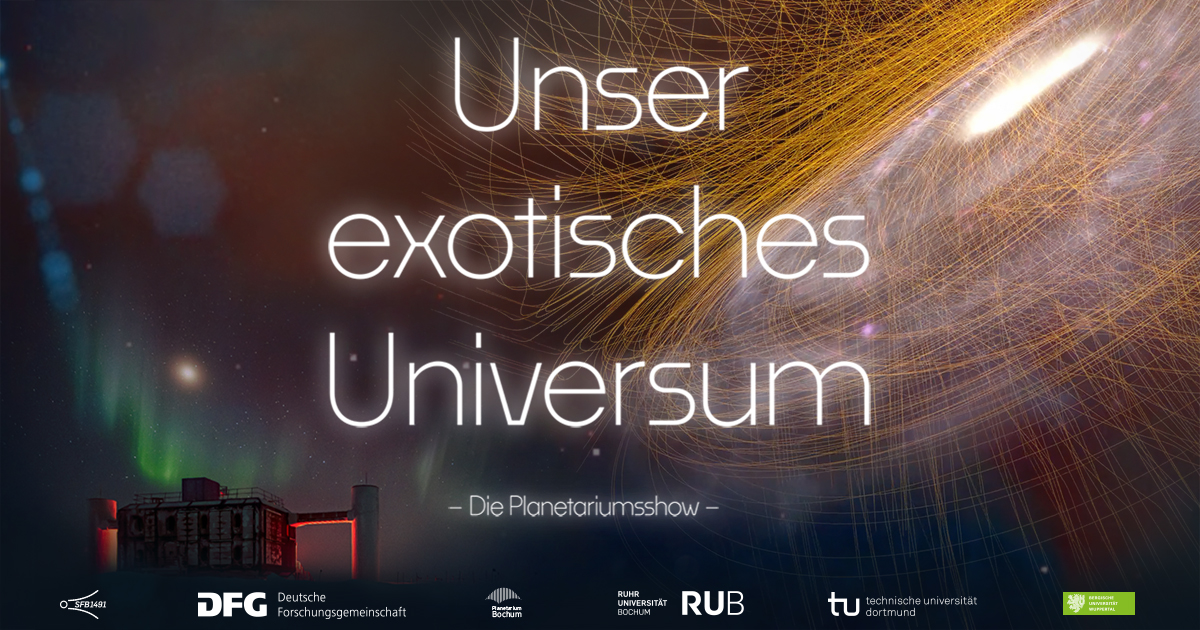
Premiere of the SFB1491 Planetarium Show
We are pleased to announce that the SFB1491 planetarium show Unser exotisches Universum will premiere on October 8, 2025, as part of the 10th anniversary ceremony of the RAPP Center.
The production offers audiences a unique glimpse into the wide-ranging research conducted within our CRC:
Combining cutting-edge scientific insights with visually stunning projections, the show takes viewers on a journey through the exciting world of modern physics and astrophysics — from experiments at the Large Hadron Collider (LHC) and cosmic rays in the Milky Way and other galaxies to stellar explosions and active galactic nuclei (AGNs).
Please note that the show is currently available in German only. An English version is in preparation.
Beginning October 12, the show will be presented regularly at the Planetarium Bochum and at other venues, including the LWL-Museum für Naturkunde mit Planetarium and Planetarium Mannheim .
Further information on the detailed schedule at the Planetarium Bochum can be found here.
Please also have a look at the RUB's News article on our show here.
© Dominik Bomans
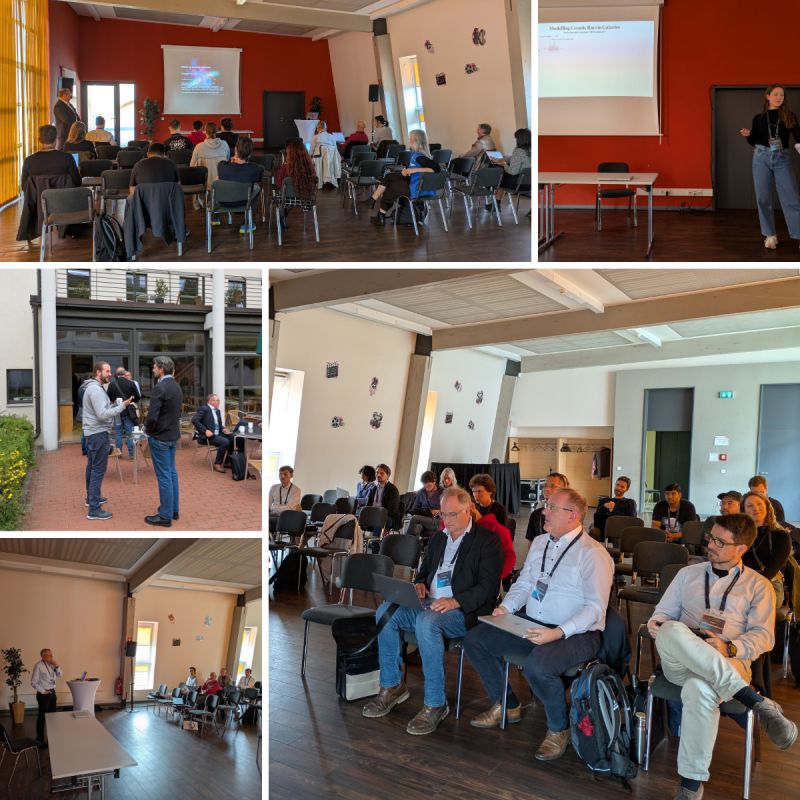
Splinter Meeting at the German Astronomical Society Annual Meeting 2025
Our CRC contributed to the 2025 Annual Meeting of the German Astronomical Society (Astronomische Gesellschaft) with the dedicated Splinter Session “Multi-messenger Signatures of Feedback Processes in Galaxies”, organized by Dominik Bomans and Dominik Elsässer.
This session brought together experts to discuss recent advances in understanding feedback mechanisms in galaxies through multi-messenger and multi-wavelength observations. The presentations and discussions explored how active galactic nuclei, massive stars, cosmic rays, and magnetic fields shape the interstellar medium, drive turbulence, and influence cosmic ray transport.
The full program can be found here.
© S. Taziaux
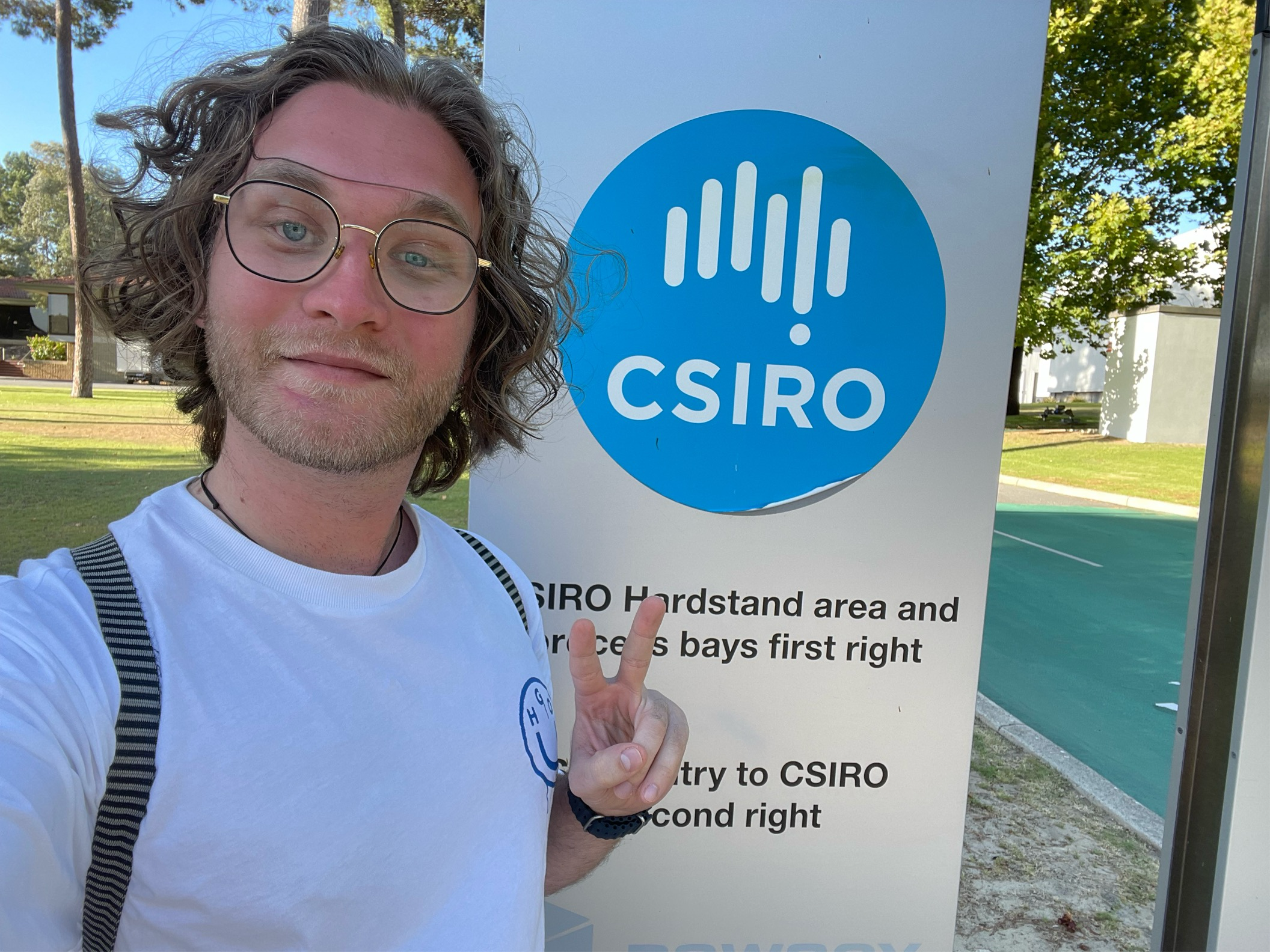
Sam Taziaux selected for CSIRO Student Program!
The CSIRO Student Program is a competitive initiative by the CSIRO, Australia’s national science agency. The program supports a small number of early-career researchers whose work aligns closely with CSIRO’s scientific priorities and who actively contribute to collaborative research with CSIRO teams.
Within project A2 of our CRC, Sam focuses on the role of magnetic fields in dwarf galaxies and the transport of cosmic rays.
As part of the CSIRO Student program, Sam will return to Perth in November 2025 for a one-month research visit, deepening the scientific collaboration and highlighting the growing ties between the SFB and CSIRO.
He will work directly with Tim Galvin, Alec Thomson, and George Heald on joint modeling approaches and data interpretation, laying the groundwork for future shared initiatives.
© Glaser
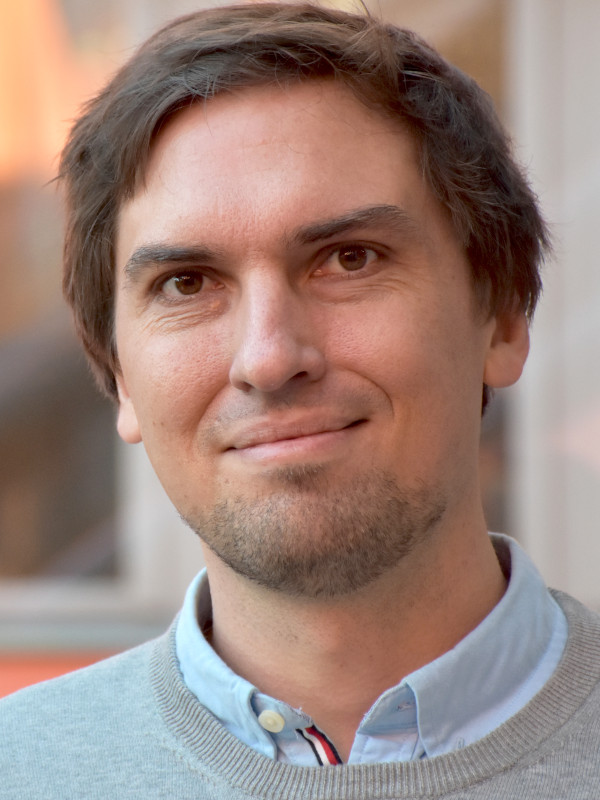
Welcome to our new PI Christian Glaser!
We are excited to announce that Dr. Christian Glaser has been appointed as a new PI at our CRC.
Christian Glaser is an astroparticle physicist at TUDO with a particular interest in artificial intelligence, high-energy cosmic neutrinos and cosmic rays. His research focuses on developing radio detectors to measure these particles. He is playing key roles in two major international projects at some of the most extreme locations on Earth: the construction of the RNO-G detector in Greenland and the development of IceCube-Gen2 at the South Pole.
He is also involved in the Pierre Auger Observatory in Argentina - the world's largest cosmic ray detector, where he is working on an improved measurement of the muon content in air showers to better understand hadronic interactions at extreme energies, a key objective in the CRC.
In addition to the theoretical modeling of radio emission and the analysis of experimental data, he is also developing new types of detection hardware.
One focus in the coming years will be the ERC NuRadioOpt project, which aims to significantly improve the performance of future neutrino detectors through the use of artificial intelligence.
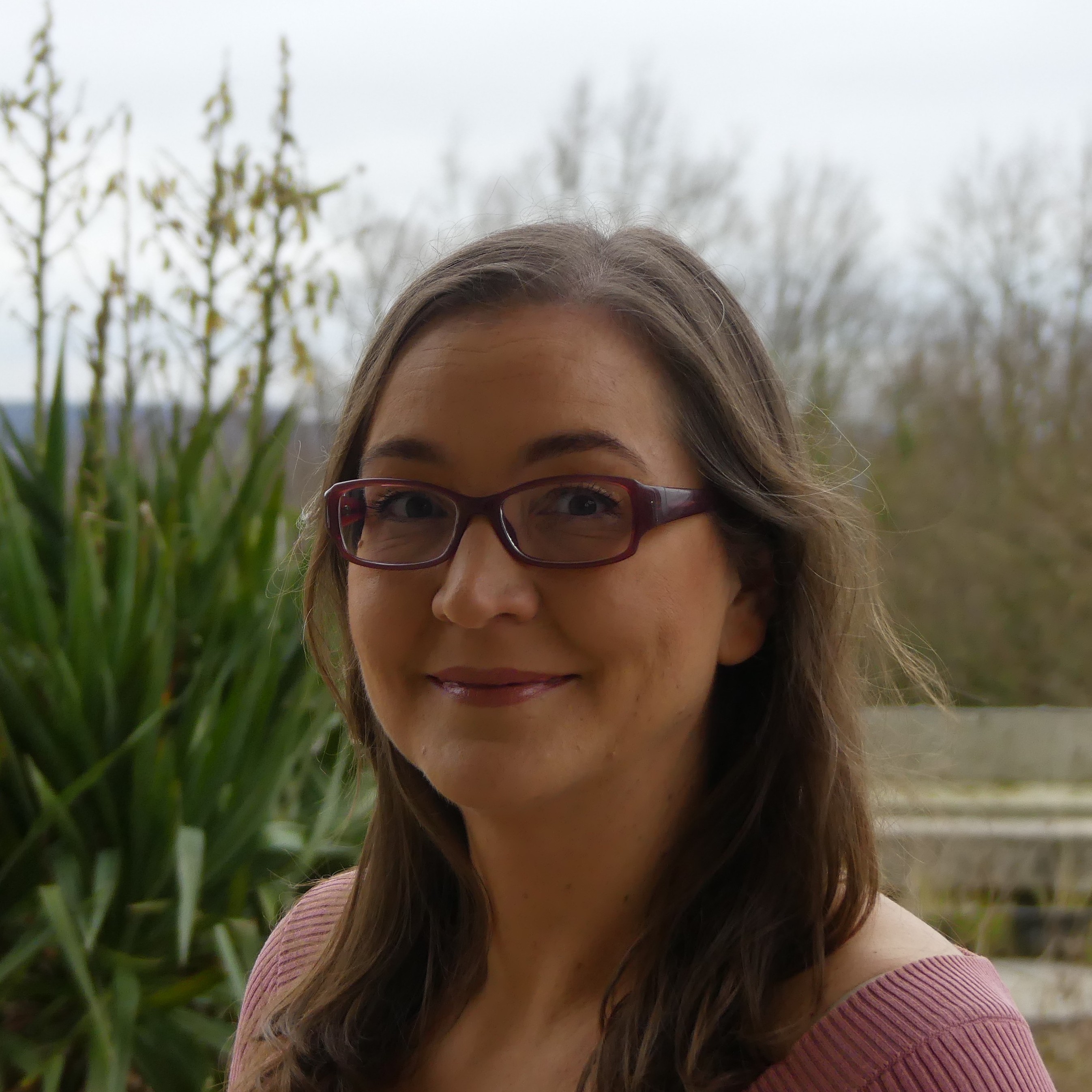
© Tjus
Julia Tjus Member of the DFG Senate
We congratulate our CRC Spokesperson Julia Tjus on her election into the Senate of the Deutsche Forschungsgemeinschaft (DFG) - German Research Foundation!
The Senate is the central scientific body that advises on all matters of fundamental importance to the DFG and, in many cases, also makes decisions.